
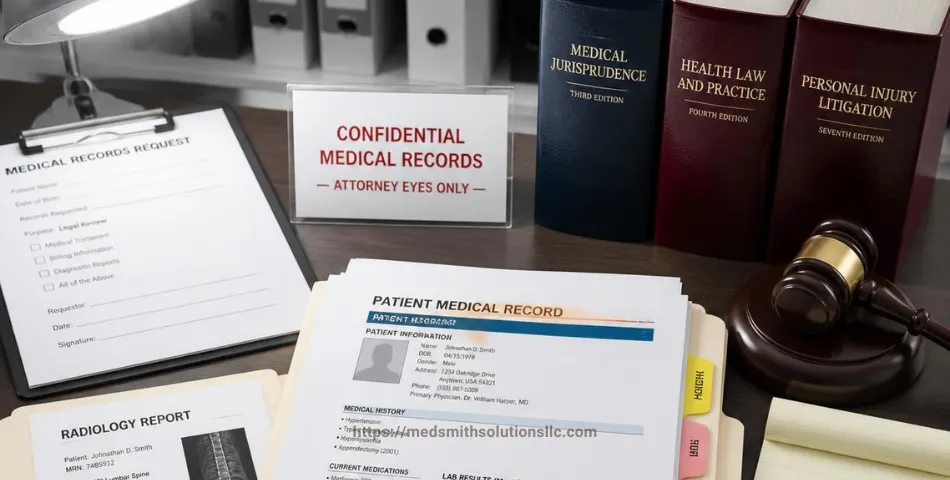
A discovery deadline is set, and the client’s medical history is scattered across four providers, two hospital systems, and a physical therapy practice that still faxes records. This is the ordinary starting point for medical records in litigation – not the polished chronology attorneys eventually work from, but the fragmented, incomplete record set that has to be assembled first. Most guidance online treats “medical records for litigation” as a single step. In practice it is three distinct stages – retrieval, organization, and review – each with its own bottlenecks, and knowing where a case is stalling determines whether the fix is a phone call to a records custodian or a decision to bring in outside support.
Talk to Our Team About Your Case
If a deadline is approaching and your record set isn’t ready, contact Medsmith Solutions for a same-week intake call. review@medsmithsolutionsllc.com | +1 415-707-3455
Table of Contents
What Medical Records for Litigation Support Means
Litigation support, in this context, is not a single service – it is the combination of record retrieval, chronological organization, gap identification, and preliminary review that has to happen before a medical chronology, narrative summary, or expert opinion can be built. Firms that treat it as one undifferentiated task tend to underestimate how much of the timeline is consumed by retrieval delays rather than analysis. A realistic litigation-support workflow for a mid-complexity personal injury or malpractice case runs through three stages.
Stage 1: Medical Record Retrieval
- HIPAA-compliant authorization drafted and sent to every identified provider – not just the ones the client remembers, but any referred specialists, imaging centers, and pharmacies named in the intake records.
- Follow-up tracking on each request, since providers routinely miss the statutory response window without a second or third request.
- Verification that what arrives is complete – partial productions (missing imaging, missing nursing notes, missing prior-treatment history) are the single most common source of delay discovered too late in a case.
Attorney Note: Build a retrieval tracking log the day the case is opened – provider name, authorization sent date, response due date, what was received, and what is still outstanding. Cases that skip this step routinely discover a missing provider’s records during deposition prep, when there is no longer time to request them.
Common Retrieval Obstacles
Retrieval rarely fails all at once – it stalls in predictable, recurring ways. Recognizing which obstacle is in play determines how quickly it can be resolved:
- Fax-only providers: Smaller practices and physical therapy offices frequently still require fax submission and manual follow-up; email or portal requests to these providers routinely go unanswered.
- Closed practices or retired physicians: Records custody often transfers to a third-party storage vendor or a state medical board archive, which adds a lookup step before a request can even be sent.
- Third-party record-copy services: Many hospital systems outsource record release to a copy service that charges per-page fees and works on its own timeline, independent of the hospital’s own responsiveness.
- Technically deficient authorizations: A HIPAA authorization missing a required element (expiration date, specific description of records requested, correct signature) is grounds for a provider to reject the request outright, restarting the clock.
- Multiple patient identifiers: A maiden name, a hyphenated name, or a date-of-birth transposition in one provider’s system can cause a “no records found” response even when records exist.
Stage 2: Organization
- Records sorted chronologically across all providers into a single sequence, not left as separate per-provider files.
- Pagination applied so specific pages can be cited precisely in deposition, motion practice, or a demand letter.
- Indexing by provider, visit type, and date range so a paralegal or attorney can locate a specific record without re-reading the full file.
- Treatment gaps flagged – unexplained lapses in care are frequently the first thing defense counsel raises, so identifying them early lets the case team address them proactively rather than reactively.
Quality Control Before a Record Set Is Considered “Litigation-Ready”
An organized record set is not automatically a reliable one. Before treating a file as complete, it’s worth running a short quality check:
- Every page is legible: faxed and scanned records frequently include pages with cut-off margins or illegible handwriting that need a re-request rather than being left as-is.
- Page numbering is continuous and matches any index or table of contents provided to the case team.
- Duplicate pages from overlapping provider productions are identified and removed or clearly marked, so they aren’t miscounted as separate visits.
- Every provider on the retrieval tracking log has either produced records or has a documented reason why not (closed practice, no records on file, litigation hold pending).
- Any billing records are cross-checked against the clinical records: a billed visit with no corresponding clinical note (or vice versa) is a discrepancy worth flagging before it surfaces in deposition.
Stage 3: Preliminary Review
Once organized, records need a first-pass review to identify what actually matters to the case theory – causation evidence, pre-existing condition documentation, treatment consistency, and any provider notes that could be used against the claim. This stage is where litigation support hands off into more specialized work: a full medical chronology, a narrative summary for a demand letter, or an expert medical opinion, depending on what the case needs next.
A useful preliminary review deliverable typically includes a short summary memo alongside the organized file – not a full chronology, but a flag list: which providers documented what condition, where the strongest causation language appears, where a defense-favorable statement exists in the record, and which pages the attorney should read first rather than last. This memo is what makes the difference between handing an attorney five hundred organized pages and handing them a usable starting point.
Handling In-House vs Bringing In Litigation Support
| Reasonable to handle in-house | Worth outsourcing to litigation support |
| Single provider, under 200 pages | Multiple providers, 500+ pages, or a hospital system with fragmented departments |
| No imminent deadline pressure | Discovery or demand deadline inside 30 days |
| Paralegal has bandwidth to manage retrieval follow-up | Retrieval has already stalled past the statutory response window |
| Straightforward treatment history | Treatment spans years, multiple injuries, or overlapping conditions |
The volume and deadline columns matter more than case type. A single-provider soft-tissue injury case with a distant trial date rarely needs outside support. A multi-provider case inside a 30-day discovery deadline almost always benefits from it, regardless of whether it’s personal injury, malpractice, or workers’ compensation.
Budgeting Time for Litigation Support
Timelines vary by state law, provider responsiveness, and case volume, but the ranges below reflect what a realistic in-house team should plan for when the workflow is actively managed rather than left to follow up on its own schedule.
| Case Profile | Realistic Retrieval-to-Organized-File Timeline |
| Single provider, straightforward request | 2–4 weeks from authorization to organized file |
| 3–5 providers, no closed practices involved | 4–6 weeks, assuming active follow-up |
| 6+ providers or any closed practice/records-storage vendor involved | 8–12 weeks, and longer if a subpoena becomes necessary |
| Mass tort or multi-plaintiff intake | Ongoing, staggered by plaintiff onboarding date rather than a single deadline |
These figures assume weekly, not one-time, follow-up on outstanding requests. Firms that request records once and wait for a response, rather than following up on a set cadence, should expect timelines at the high end of these ranges or beyond – which is precisely the gap litigation support is built to close.
Common Mistakes That Delay a Litigation-Ready Record Set
- Waiting until a deadline is close to start retrieval, rather than opening requests at intake regardless of how far off trial or discovery appears.
- Treating the first batch of records received as complete, without cross-checking it against a full provider list built from the client intake interview.
- Skipping pagination until “it’s needed,” which usually means re-doing it under time pressure right before a deposition or demand letter deadline.
- Assuming a records custodian’s silence means the request was received; non-response should trigger a follow-up call, not an assumption.
- Not tracking which authorization version was sent to which provider – a common problem when an authorization is revised mid-case and older, outdated copies are still circulating with some providers.
Litigation Support Across Case Types
The retrieval-organization-review workflow above applies across practice areas, though the emphasis shifts. In mass tort litigation, the volume and provider count multiply, which is a distinct enough problem to warrant its own approach – see our dedicated guide on reviewing records in mass tort litigation. In workers’ compensation, treatment gaps and functional capacity documentation carry more weight than in a standard personal injury claim, since insurers frequently use gaps to argue a claimant has recovered or was never as impaired as alleged.
In nursing home negligence cases, staffing schedules and medication administration records become as important as clinical notes, since understaffing and missed medication administration are common negligence theories that clinical notes alone won’t establish. In medical malpractice specifically, the standard-of-care analysis depends on having every provider’s complete record, since an incomplete record set can allow defense counsel to argue that a treatment decision looked reasonable given what that provider actually had in front of them at the time. The underlying process is the same across all of these; what changes is which records get prioritized first and which gaps get flagged as case-critical rather than merely incomplete.
How Medsmith Solutions Supports the Litigation Record Workflow
Medsmith Solutions manages retrieval follow-up, chronological organization, pagination, and preliminary review as a single handoff – so a case that arrives as a stack of fragmented provider files leaves as an organized, cited record set ready for chronology, narrative summary, or expert review work.
Send Us Your Case File
Upload what you have – even an incomplete or unorganized record set – and our team will identify outstanding providers, manage retrieval follow-up, and return an organized, paginated file. Start here!
Frequently Asked Questions
How long does medical record retrieval typically take?
Most providers have a statutory response window (commonly 15–30 days depending on state law), but in practice, non-response and follow-up requests routinely push single-provider retrieval past 45 days. Multi-provider cases should be budgeted for 60–90 days unless retrieval is actively managed and escalated.
What’s the difference between litigation support and a medical chronology?
Litigation support is the retrieval, organization, and preliminary review that has to happen first. A medical chronology is a more detailed, narrative-ready output built from that organized record set – litigation support is the input, the chronology is one possible output.
Can litigation support help if records have already been requested but not received?
Yes, this is one of the more common entry points. Escalated follow-up and, where needed, formal subpoena support can move a stalled request that has already missed its response window.
Does litigation support cover records for expert witness review?
It prepares the record set an expert would need – organized, paginated, and gap-flagged – but the expert’s own opinion is a separate work product, typically handled through a dedicated expert medical opinion engagement.
Should litigation support start before a case is confirmed to move forward?
Yes, in most cases. Because retrieval is the slowest stage and depends on factors outside the firm’s control, starting it at intake – even before a full case strategy is set – avoids a scenario where the records aren’t ready by the time they’re needed for a demand letter, mediation, or filing deadline.
